Tuesday, 15 September 2015

Lesson 7 - Is intelligence what intelligence tests measure?

Are you Smarter Than These Celebrities?

Key Values

Homework task
No formal homework from this lesson.

Exam Revision Questions
Learning Activity 11.17 (Q1 - 4, p. 431) 
Learning Activity 11.20 (Q1 - 5, p. 433) 
Learning Activity 11.22 (Q1 - 5, p. 436) 


Lesson Resources
PPT

Enter Teacher's Room Code: QE2GJ9KG ---> Join Room
Student Code: Your number (e.g. 555)

Lesson 6 - How can we prevent a culturally biased test?

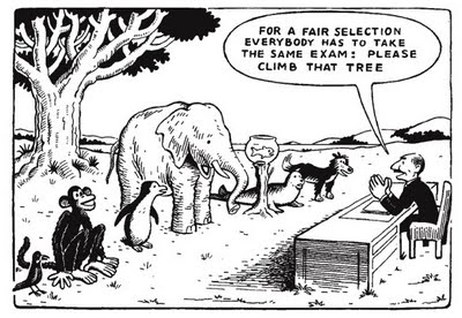
How is this not a fair test for intelligence?

Key Knowledge
  • Strengths and limitations of scientific methodologies used to measure intelligence the Wechsler’s intelligence scales.
Homework task 
No formal homework from this lesson. 

Exam Revision Questions
Learning Activity 11.3 (Q1 - 3, p. 409)

Lesson Resources


Lesson 6 - Dietrich v The Queen (1992)

All About - Dietrich v The Queen

Key Knowledge
An Australian case that illustrates rights issues and the empowerment of the people, and its impact on the legal system: 
  • The role of an individual or group launching a test case. 
  • Facts and issues central to the case - a question of rights. 
  • Conflicting attitudes. 
  • Laws applied to the case. 
  • Outcome of the case. 

Homework task
  • Check your understanding (Q1 - 5, p. 473). 
Submission Requirements
  • Due for checking on Tuesday 15th September. 
Lesson Resources

Lesson 5 - How can we measure intelligence in children?

How has the Stanford and Binet tests changed over time? 

Key Knowledge and Skills
  • Participate in a range of emotional activities encompassing Peter Salovey and John Mayer's ability - based model of emotional intelligence. 
  • Strengths and limitations of scientific methodologies used to measure intelligence: Intelligence Quotient (IQ), Stanford-Binet test and Wechsler’s intelligence scales.
Homework task
  • Poster about yourself! (BRT)
Submission Requirements
Hand it to Miss. B on Monday 14th September.

Exam Revision Questions
Learning Activity 11.2 (Q1 - 3, p. 407)
Lesson Resources

Roach v Electoral Commissioner (2007) Timeline Activity

Vicki Lee Roach receives her degree.

Summary of the case

Vicki Lee Roach was a Victorian woman of Aboriginal descent, who was serving a six year term of imprisonment, having been convicted on five counts of offences that included burglary, conduct endangering persons and negligently causing serious injury. She challenged the validity of the 2006 amendments made to the Electoral Act 1918 (Cth), by the passage of the Electoral and Referendum Amendment (Electoral Integrity and Other Measures) Act 2006 (Cth). The amendments prohibited all prisoners who were serving a sentence of imprisonment for a Commonwealth, state or territory offence from voting in federal elections. Before the amendment only those prisoners serving a sentence of three years or longer were excluded from voting. Thus, Ms Roach was excluded from voting.

Ms Roach’s challenge to the validity of the 2006 amendment was heard by the High Court in September 2007.

The High Court held that the complete ban on prisoners voting was unconstitutional, as it was inconsistent with the principles of representative government. This principle requires that members of parliament are elected into office by the people they seek to represent. Sections 7 and 24 of the Constitution require that Senators and members of the House of Representatives are directly chosen by the people; therefore there is a right to vote, that had been violated by this legislation. The 2006 amendment was declared to be invalid.

The outcome of the case had far reaching implications for the legal system in terms of recognising that there is a constitutionally protected right to vote in Australia.
However, as Vicki Lee Roach was serving a prison term of longer than three years, and the original provisions of the Electoral Act were upheld, Ms Roach was still ineligible to vote in elections. 


References you can use for the timeline

Example of a timeline
Group 1 | Previous rights from the Electoral Commission on prisoners.

Group 2 | History of Vicki Lee Roach. 

Group 3 | How she challenged the law. 

Group 4 | Conflicting attitudes.

Group 5 | Outcomes. 

Group 6 | Impact of the case.

Remember each group needs to have one person using the textbook, one using online references and the poster creator! 


Sunday, 13 September 2015

Letter to the Doctor

For those who are yet to complete their letter due to Drivers Ed,  instructions are listed here: 
Instead of writing 350 - 400 words, you will write 300 words. 

Submission Requirements
Please submit the letter either printed out, emailed or on a USB on Wednesday 16th September.

An excellent student example of a letter to the doctor:
Success criteria
  1. A description of the disease. ✓
  2. The symptoms you have been experiencing at any stage of diagnosis. ✓
  3. How it is caused. ✓
  4. The current research on gene therapy for your disease. ✓
  5. Risks and issues with the procedure. ✓
  6. Alternative treatments. ✓
  7. Final statement whether you would or wouldn't seek gene therapy.  ✓
...

Dear Dr Smith,

I’m a student studying science and I have recently been diagnosed with muscular dystrophy which is a genetic disorder that causes progressive weakness and degeneration of the muscles that help the body move. Muscular dystrophy can occur at any age and those who are affected gradually lose the ability to do things such as walking and sitting upright, each disorder has different degrees of carer and mobility needs and independence. There are 30 different types of muscular dystrophy and some are further divided into sub-types. I’m currently awaiting blood test results with the specific type of disorder that I have.

I have done some research and found out that some symptoms of muscular dystrophy include a waddling walk, well-developed or excessively large calf muscles with other muscles poorly developed or a sway back (lordosis). I personally have a tendency to stand and walk on the forefoot, with the heel off the ground and suffer from frequent falls and difficulty rising up from the ground or going up hills or stairs.

Muscular dystrophy is caused when people such as I, have incorrect or missing information in their genes, this prevents us from making proteins that are needed for healthy muscles. The disorder can be diagnosed through genetic testing, a blood test; which will show very high levels of protein called creatine phosphokinaseand which is how I found out about my disorder, a muscle biopsy; the removal of a small piece of muscle tissue that is then examined under a microscope or electromyography; insertion of a thin needle that checks the health of the muscles and the nerves that control the muscles.

I have been told that there is currently no cure for muscular dystrophy but several possible treatments are beginning to emerge and are in clinical trial because of medical researches building a greater understanding of MD. However, the discovery of a cure for one type of muscular dystrophy may not necessarily help in curing another type.

Identifying the right form of a gene to deliver is the most current research that gene therapy is focused on in MD, as well as developing methods for safe and efficient delivery to muscle. According to other doctors the task is not easy to perform due to many of the genes being huge and they present complex expression patterns. For a successful delivery it must overcome immunological and physical barriers, but I am willing to undergo this method. 

I have been told that although there is currently no cure for muscular dystrophy, there are alternative treatments to help relieve symptoms of the disorder such as exercise and physical therapy to minimize abnormal or painful positioning of the joints as well as respiratory care, coughing and deep breathing exercises. Surgery can also sometimes relieve muscle shortening and canes, powered wheelchairs and other rehabilitative devices can help those with MD maintain mobility and independence.

I am writing to you because I would like to have genetic therapy as I am feeling a lot of pain and physical therapy isn’t doing the job for me. I want to undergo this kind of treatment because there is a chance of a positive outcome.

Kind regards,


B.C


Tuesday, 8 September 2015

Lesson 5 - Mabo v Queensland (1988)


"This weekend marks the 20th Anniversary of the High Court of Australia's decision to recognise Native Title. And her on Mabo Day in Townsville - many of the local community have gathered to remember the man who led the legal challenge for land rights - Eddie Mabo" 


Key Knowledge
An Australian case that illustrates rights issues and the empowerment of the people, and its impact on the legal system: 
  • The role of an individual or group launching a test case. 
  • Facts and issues central to the case - a question of rights. 
  • Conflicting attitudes. 
  • Laws applied to the case. 
  • Outcome of the case. 
Homework task

Submission requirements
Due Date: Friday 11th September 
Be ready for checking otherwise you will receive a lunch time detention on the day. 

Lesson Resources
PPT

What do we know about Mabo?